Pigments, Binders, Varnishes, and Artists’ Materials
Vermillion
Vermilion is one of those pigments whose visual brilliance conceals a surprisingly complex history.
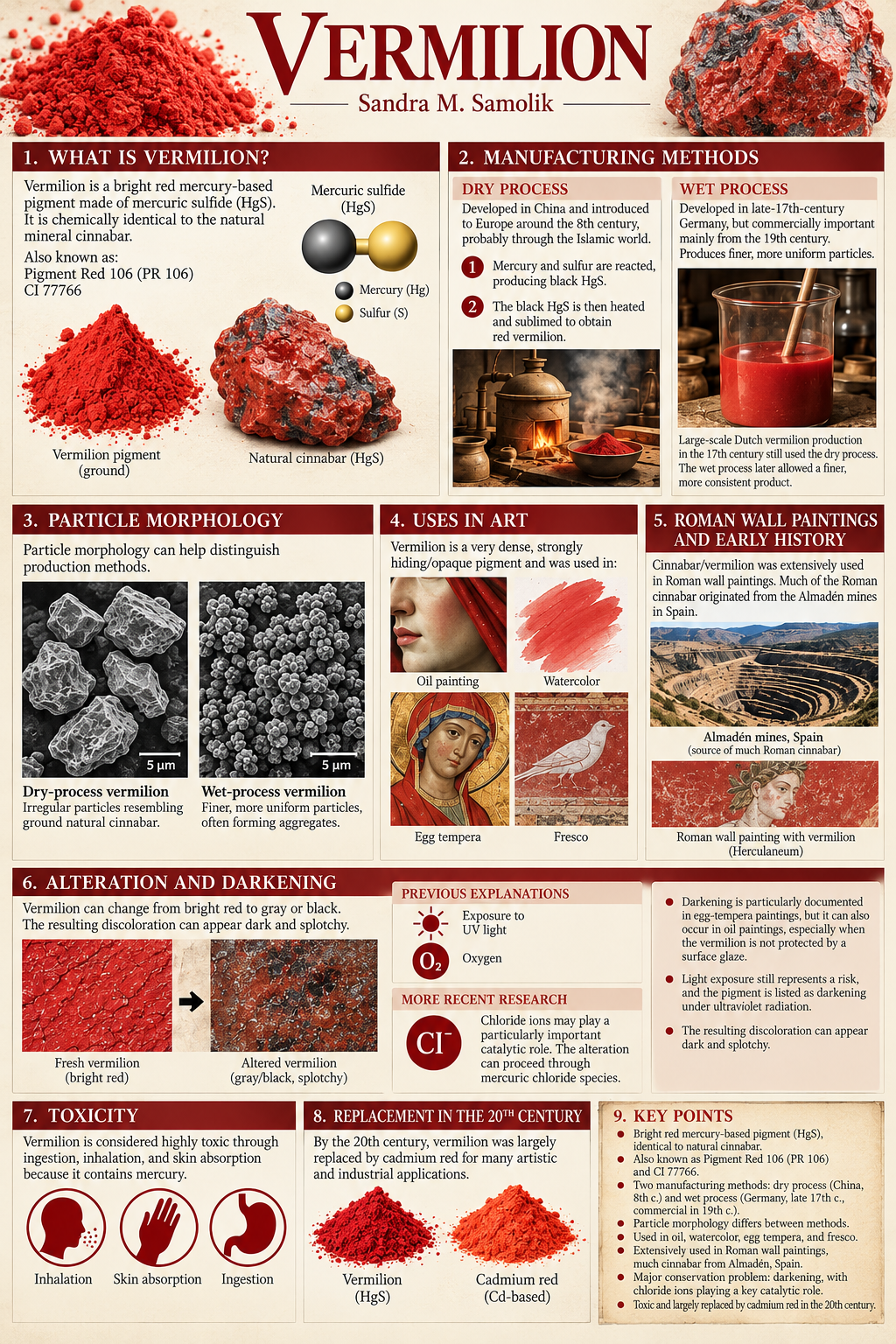
Chemically, vermilion is mercuric sulfide (HgS), identical to the natural mineral cinnabar. Its manufacture developed through different processes, from the early dry method associated with China and its later transmission to Europe, to the wet process developed in Germany and commercialized more widely in the 19th century.
The pigment became valued for its density, opacity, and intense red color and was used across oil painting, watercolor, egg tempera, and fresco. Cinnabar and vermilion also played an important role in Roman wall painting, with major historical supplies connected to the Almadén mines in Spain.
From a conservation perspective, however, vermilion is especially interesting because of its tendency to darken. Once explained mainly through light and oxygen exposure, more recent research has highlighted the potentially important catalytic role of chloride ions and the formation of mercury-chloride species.
Particle morphology can also provide useful evidence about manufacturing history, with dry-process and wet-process vermilion showing different particle characteristics under magnification. And there is another important consideration: mercury. Vermilion requires careful handling because of its toxicity, particularly where pigment dust may be inhaled or ingested.
By the 20th century, cadmium red had replaced vermilion in many artistic and industrial applications, but vermilion remains an important pigment for understanding historic materials, manufacturing technology, artistic practice, and conservation change.
© 2026 Sandra M. Samolik. All rights reserved. Text and figures on this page may not be copied, downloaded, or redistributed without prior written permission.