Pigments, Binders, Varnishes, and Artists’ Materials
Understanding Color in Art
Concepts such as hue, saturation, tone, tint, and shade help distinguish between different aspects of color that might otherwise be described simply as “lighter,” “darker,” or “more colorful.” In art history, conservation, technical examination, and studio practice, those distinctions matter.
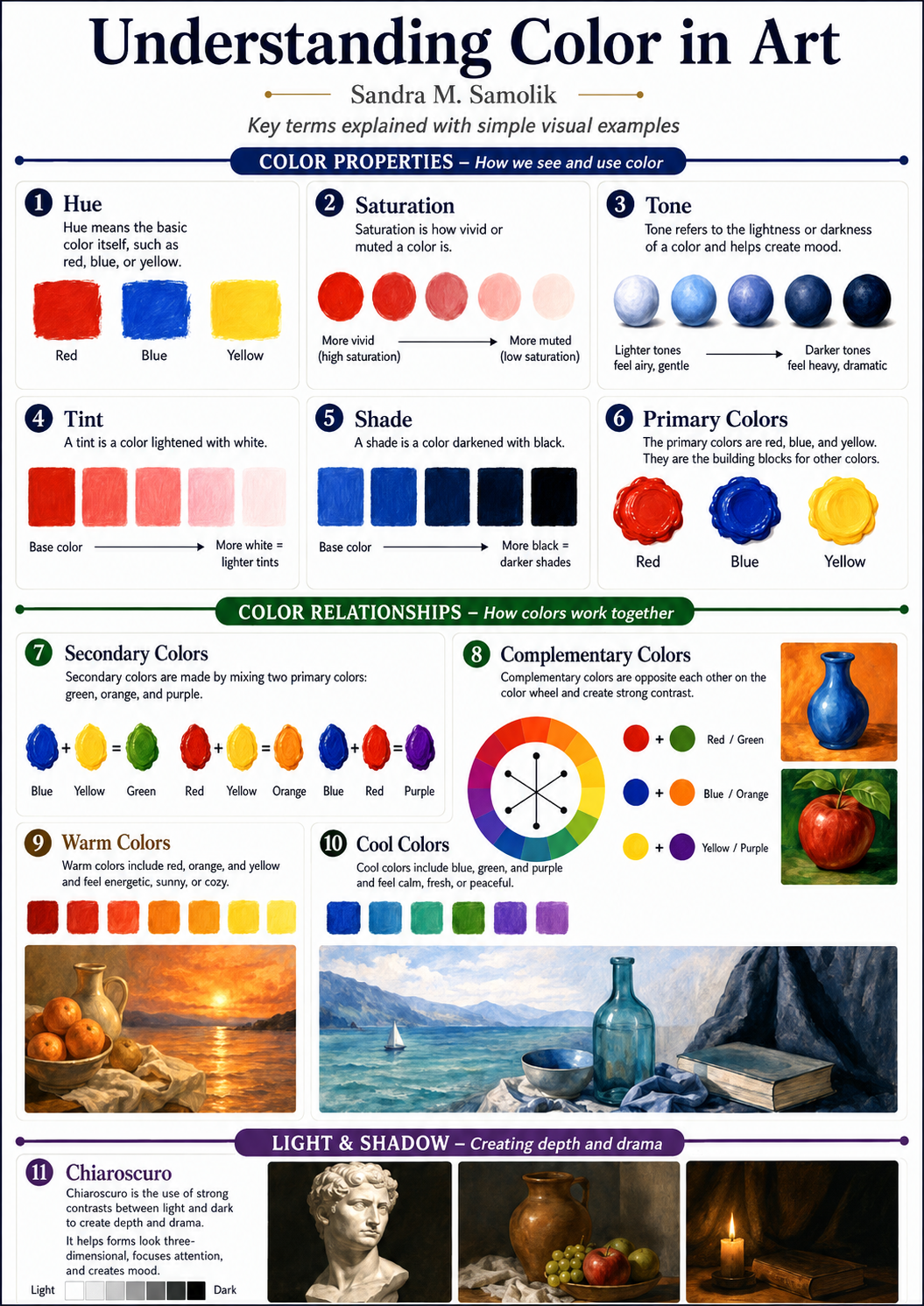
Understanding color terminology is more than learning the vocabulary of art. These terms give us a precise way to describe, analyze, compare, and communicate what we see.
Concepts such as hue, saturation, tone, tint, and shade help distinguish between different aspects of color that might otherwise be described simply as “lighter,” “darker,” or “more colorful.” In art history, conservation, technical examination, and studio practice, those distinctions matter.
Understanding primary, secondary, complementary, warm, and cool colors also helps explain how artists construct relationships within a composition. Color can guide the eye, create contrast, establish harmony, suggest spatial depth, and influence the atmosphere of an artwork.
The same is true of chiaroscuro. The deliberate relationship between light and shadow is not merely decorative; it can shape volume, direct attention, heighten drama, and fundamentally change how we perceive a painted form.
For researchers and conservators, this vocabulary becomes especially useful when documenting condition, discussing changes in appearance, examining an artist’s technique, or communicating observations across disciplines.
Learning these terms therefore provides something very practical: a shared visual language for looking more carefully at art.
© 2026 Sandra M. Samolik. All rights reserved. Text and figures on this page may not be copied, downloaded, or redistributed without prior written permission.