Digital Heritage
The Entry-Level (Low-End) Art Market
The entry-level art market deserves far more attention than it usually receives. Works priced under $5,000 account for roughly 76% of art-market transactions, yet only around 4% of total sales value, according to recent research.
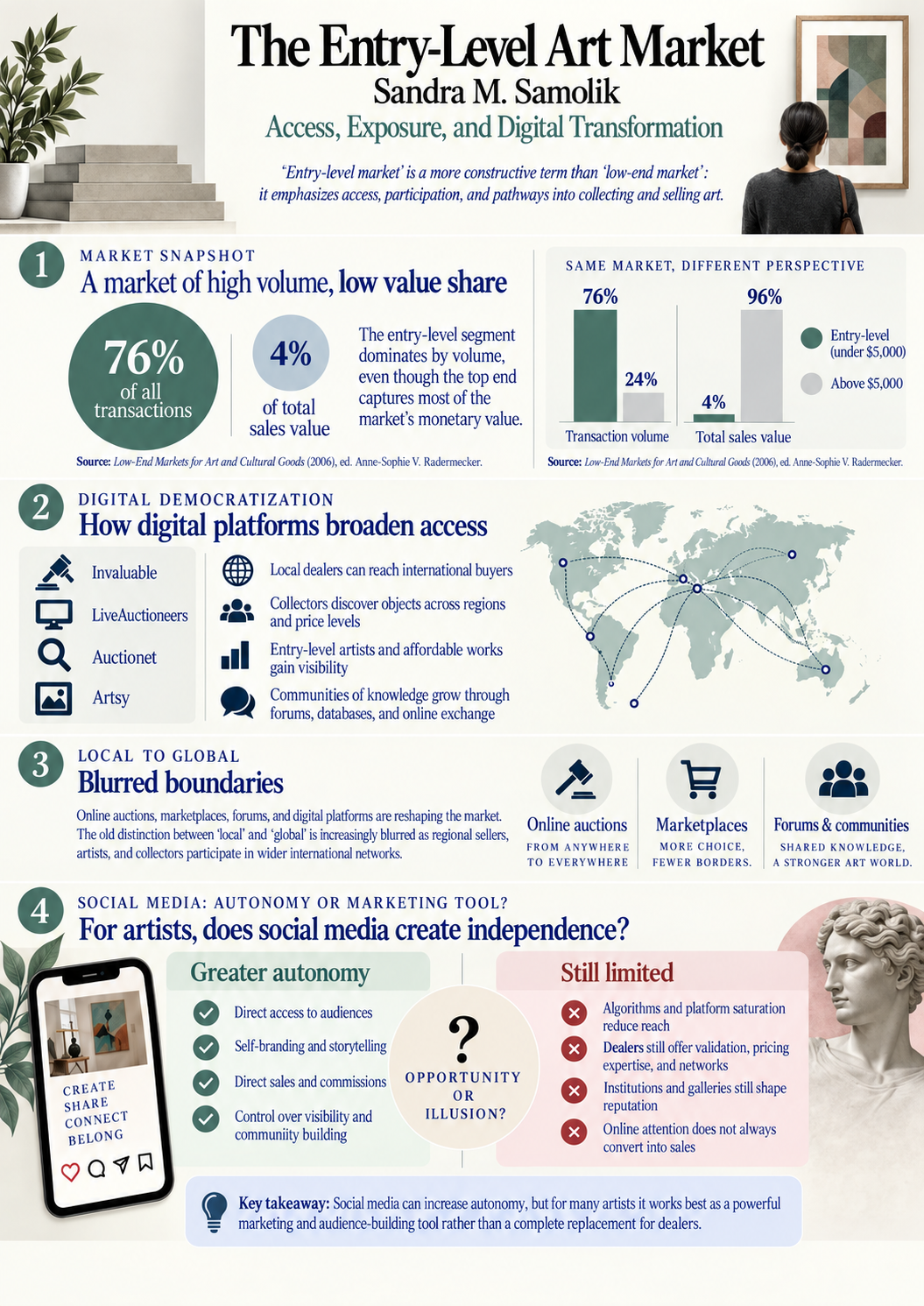
The entry-level art market deserves far more attention than it usually receives. Works priced under $5,000 account for roughly 76% of art-market transactions, yet only around 4% of total sales value, according to recent research.
In other words, the lower-priced segment represents an enormous share of actual market activity, even if headlines remain dominated by multimillion-dollar sales.
This is also where digital transformation becomes especially interesting.
Platforms such as Invaluable, LiveAuctioneers, Auctionet, Artsy, eBay, Catawiki and others are helping regional auction houses, dealers, collectors, and artists reach audiences far beyond their traditional geographic markets. Online auctions, marketplaces, databases, forums, and collector communities increasingly blur the distinction between what is “local” and what is “global.”
But social media raises another question: Does greater visibility actually create greater independence for artists?
Instagram, TikTok, Facebook, YouTube and similar platforms can certainly give artists more autonomy. They can build their own audiences, communicate their artistic identity directly, document their practice, generate commissions, and sometimes sell without traditional intermediaries.
Yet visibility is not the same as market validation.
Dealers, galleries, auction houses, curators, critics, museums, and established networks still contribute expertise, reputation, pricing structures, market positioning, and access to collectors. Algorithms can also determine who becomes visible, while large audiences do not necessarily translate into sustainable sales.
Perhaps social media should therefore be understood not simply as a replacement for traditional intermediaries, but as a new layer of agency within the art-market ecosystem.
© 2026 Sandra M. Samolik. All rights reserved. Text and figures on this page may not be copied, downloaded, or redistributed without prior written permission.