Technical Art History
Scientific Examination of Paintings
This post highlights how physical and chemical methods can reveal what is not immediately visible to the eye: underdrawings, pentimenti, restoration campaigns, overpaint, varnish layers, pigment composition, structural changes, and evidence relevant to provenance and authenticity.
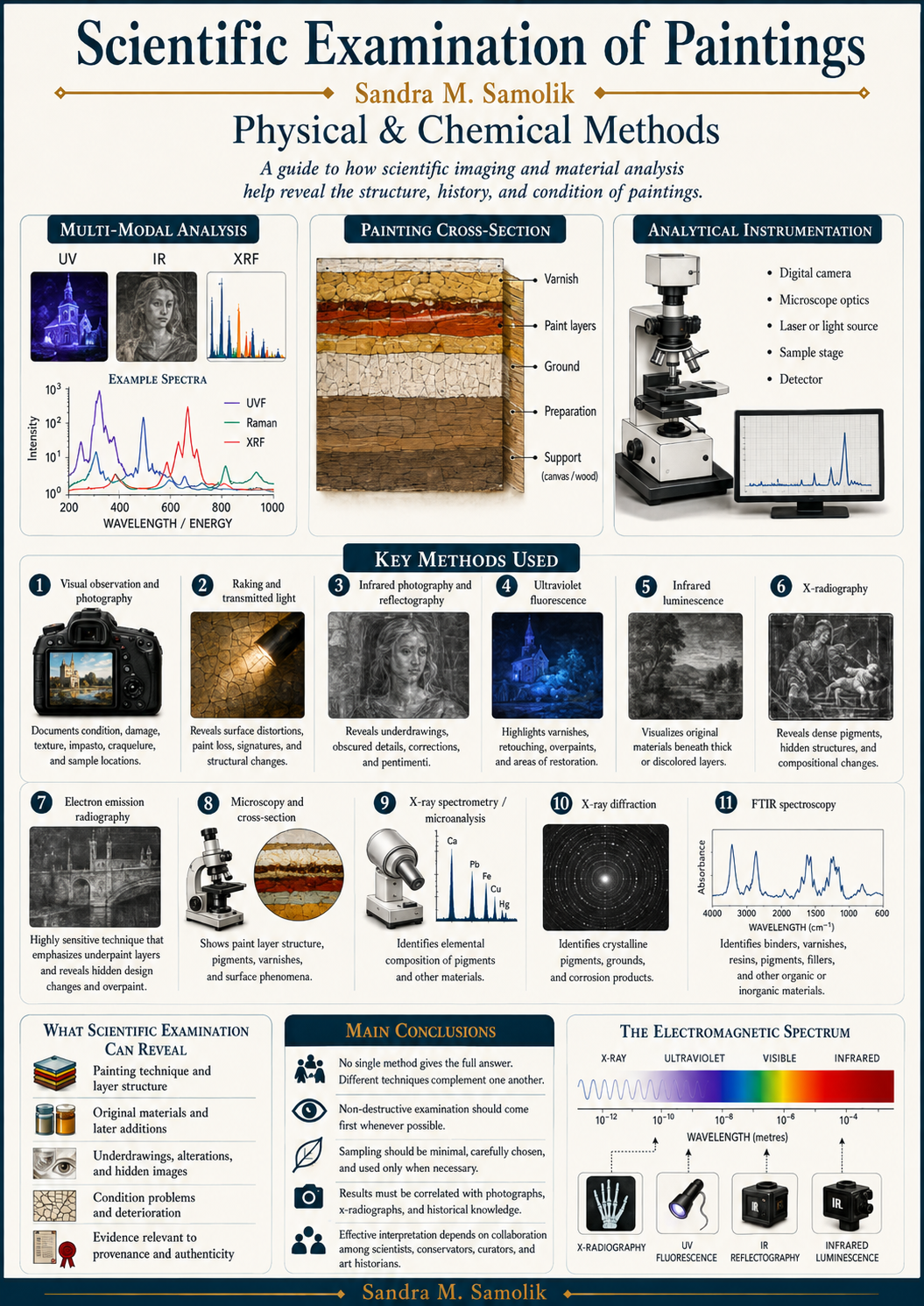
Scientific examination has become essential to the study, conservation, and authentication of paintings.
This post highlights how physical and chemical methods can reveal what is not immediately visible to the eye: underdrawings, pentimenti, restoration campaigns, overpaint, varnish layers, pigment composition, structural changes, and evidence relevant to provenance and authenticity.
Techniques such as infrared reflectography, ultraviolet fluorescence, x-radiography, microscopy, cross-sections, x-ray spectrometry, x-ray diffraction, and FTIR spectroscopy allow conservators, scientists, curators, and art historians to investigate paintings through multiple layers of evidence.
One of the most important lessons is that no single method can provide a complete answer. Reliable interpretation depends on the careful correlation of imaging, material analysis, historical documentation, provenance research, and expert judgment.
For art authentication, conservation science, and provenance research, this interdisciplinary approach is crucial. It reminds us that scientific data must be interpreted within the broader context of an artwork’s material history, condition, technique, and documented ownership.
© 2026 Sandra M. Samolik. All rights reserved. Text and figures on this page may not be copied, downloaded, or redistributed without prior written permission.