Digital Heritage
Provenance Research: Documentation, Gaps, Archival Fragmentation and the Significance of Terminology
Provenance research is not simply about reconstructing a list of previous owners. It is also about understanding how information was recorded, described, separated, preserved, and sometimes lost.
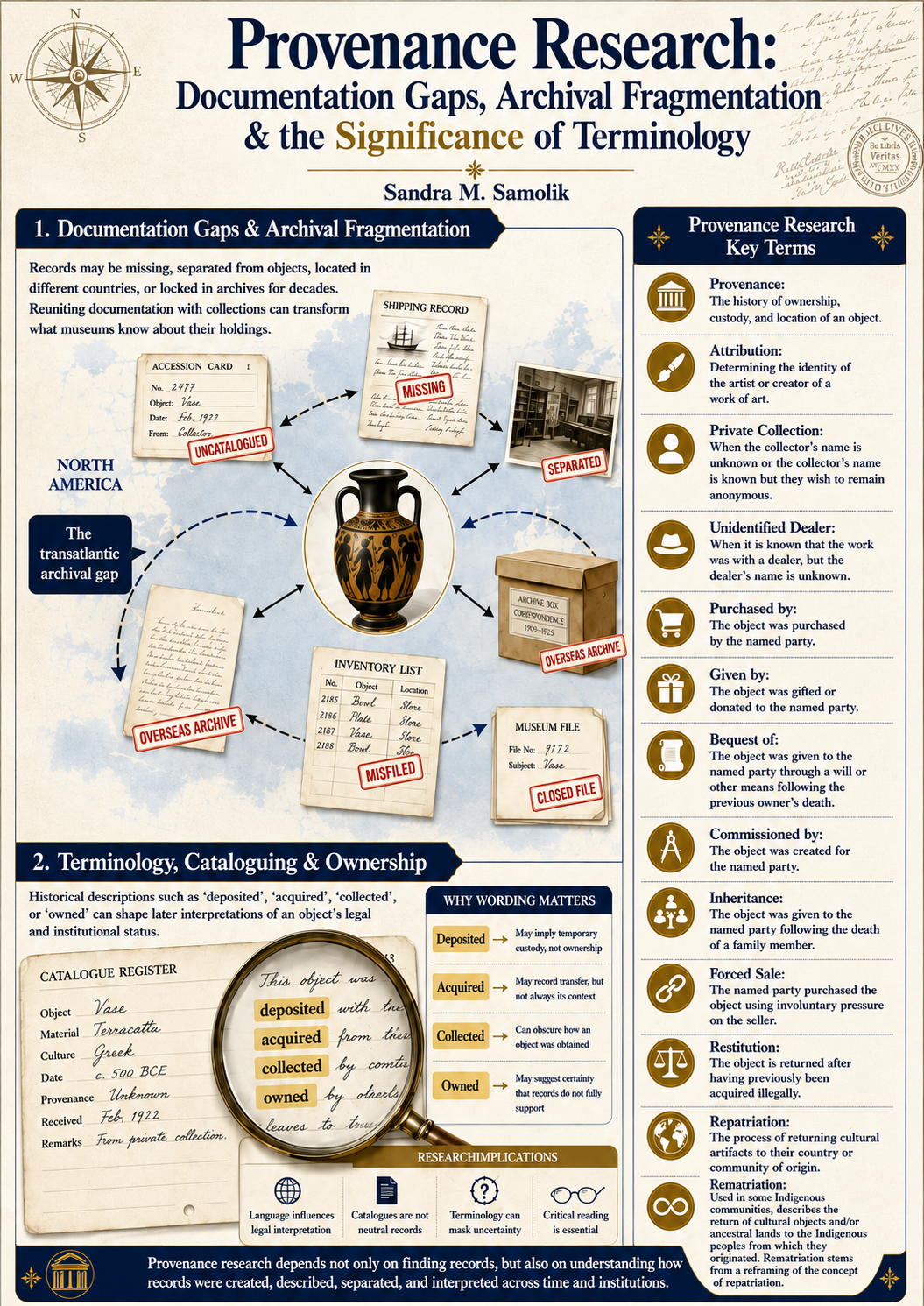
Provenance research is not simply about reconstructing a list of previous owners. It is also about understanding how information was recorded, described, separated, preserved, and sometimes lost.
Documentation gaps and archival fragmentation can significantly affect what we know about an object. Records may be missing, misfiled, held in different institutions, located in another country, or separated from the collection they originally documented. Reconnecting objects with their archival records can reveal previously unknown ownership histories, clarify transfers, and sometimes fundamentally change the interpretation of a collection.
Terminology presents another challenge. Words such as “deposited,” “acquired,” “collected,” “purchased,” or “owned” may appear straightforward, but their historical meaning and institutional use can differ considerably. A catalogue entry is therefore not necessarily a neutral statement of ownership. The language used by museums, dealers, collectors, and archives needs to be examined within its historical and legal context.
Terms such as attribution, private collection, unidentified dealer, bequest, inheritance, forced sale, restitution, repatriation, and rematriation also carry specific meanings within provenance research. Understanding these distinctions is essential when reconstructing an object's history and assessing the circumstances under which it moved between people, institutions, and countries.
Provenance research therefore depends not only on finding documentation, but on critically interpreting what that documentation actually tells us and recognizing what it may leave unresolved.
© 2026 Sandra M. Samolik. All rights reserved. Text and figures on this page may not be copied, downloaded, or redistributed without prior written permission.