Digital Heritage
OCR and Automated Correction in Art Provenance
Can a cleaner transcription make provenance research less reliable? Historical auction catalogues, dealer stockbooks, archival inventories, labels, inscriptions, letters, and invoices are increasingly processed through OCR and automated correction systems. These tools make vast collections searchable, but correction is never entirely neutral.
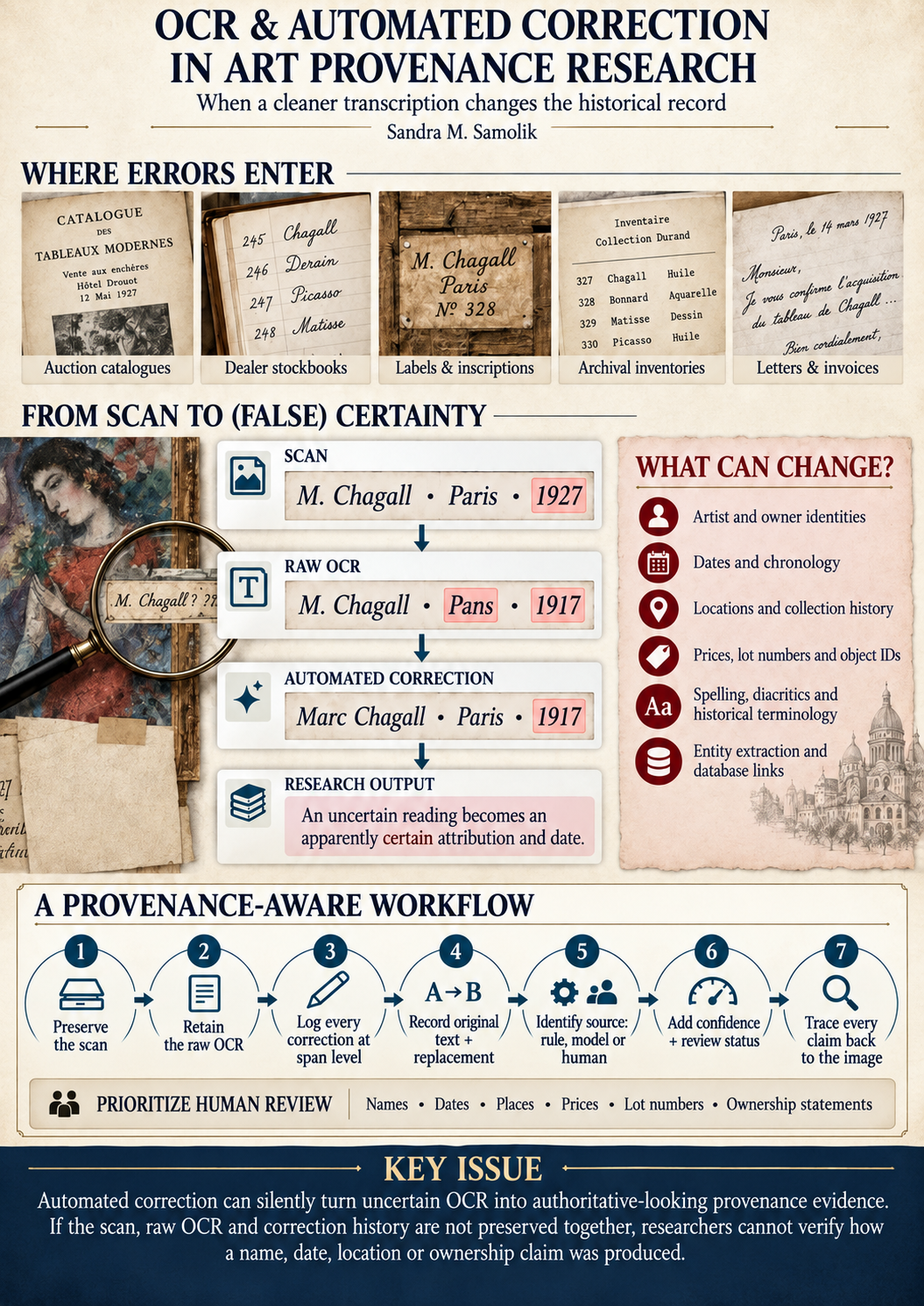
Can a cleaner transcription make provenance research less reliable?
Historical auction catalogues, dealer stockbooks, archival inventories, labels, inscriptions, letters, and invoices are increasingly processed through OCR and automated correction systems. These tools make vast collections searchable, but correction is never entirely neutral.
A question mark can disappear. A surname can be assigned to the wrong person. “1927” can become “1917.” Once that corrected reading enters an entity-extraction system, database, or AI research pipeline, an uncertain interpretation may gradually acquire the appearance of an established fact.
For art provenance research, the consequences can be significant: incorrectly identified owners or artists, broken chronologies, false locations, altered prices and lot numbers, and misleading connections between objects and historical records.
The solution is not to reject automation, but to document its interventions. The original scan and raw OCR should be preserved, every correction recorded, and its source, confidence, and review status made visible. Most importantly, every resulting provenance claim should remain traceable to the historical image from which it originated.
Automated correction should be treated as an interpretive intervention, not invisible technical cleanup.
Corrections must remain visible, reversible, and auditable.
© 2026 Sandra M. Samolik. All rights reserved. Text and figures on this page may not be copied, downloaded, or redistributed without prior written permission.