Pigments, Binders, Varnishes, and Artists’ Materials
Natural vs. Synthetic Resins
Resins are everywhere, in natural varnishes, adhesives, coatings, composites, construction materials, and even aerospace applications. But not all resins are chemically the same.
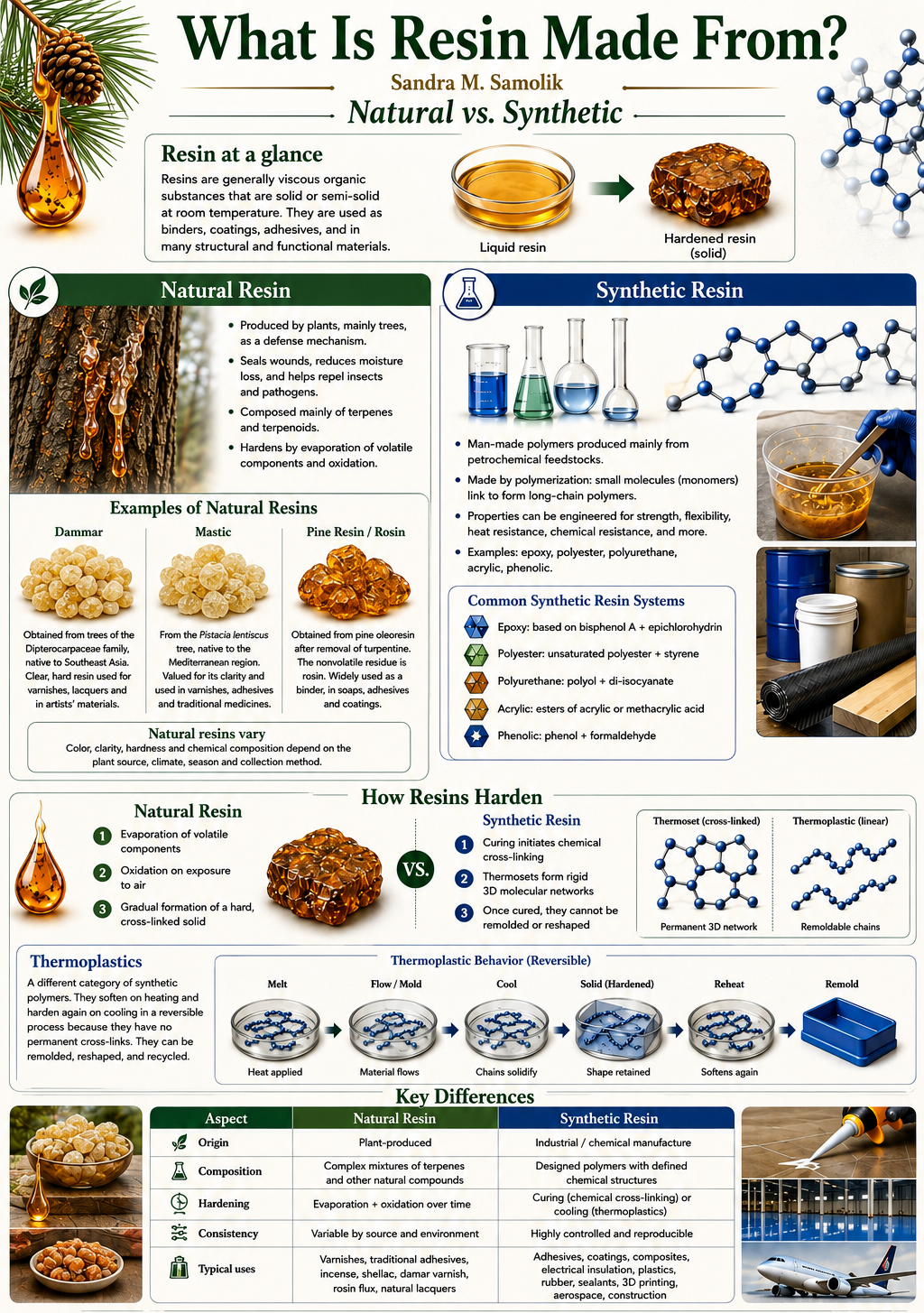
Resins are everywhere, in natural varnishes, adhesives, coatings, composites, construction materials, and even aerospace applications. But not all resins are chemically the same.
Natural resins are produced biologically, primarily by plants. They are complex mixtures rich in terpenes and terpenoids and typically harden through the evaporation of volatile components and oxidation. Over geological timescales, some natural resins can undergo further polymerization and fossilization, producing materials such as amber.
Synthetic resins, by contrast, are engineered polymers. Their molecular structures can be designed to achieve specific properties such as strength, flexibility, chemical resistance, and thermal stability. Common examples include epoxy, polyester, and polyurethane resins.
Another important distinction is how they harden. Thermosetting resins cure through irreversible cross-linking, creating rigid three-dimensional networks. Thermoplastics behave differently: they soften when heated and harden again when cooled, allowing them to be reshaped.
For art conservation and materials research, understanding these differences is especially important. Natural and synthetic resins age differently, interact differently with solvents and environmental conditions, and can require very different approaches to identification, treatment, and preservation.
© 2026 Sandra M. Samolik. All rights reserved. Text and figures on this page may not be copied, downloaded, or redistributed without prior written permission.