Pigments, Binders, Varnishes, and Artists’ Materials
Lead Pigments - How Lead White and Red Lead Change
Why do lead white and red lead darken?
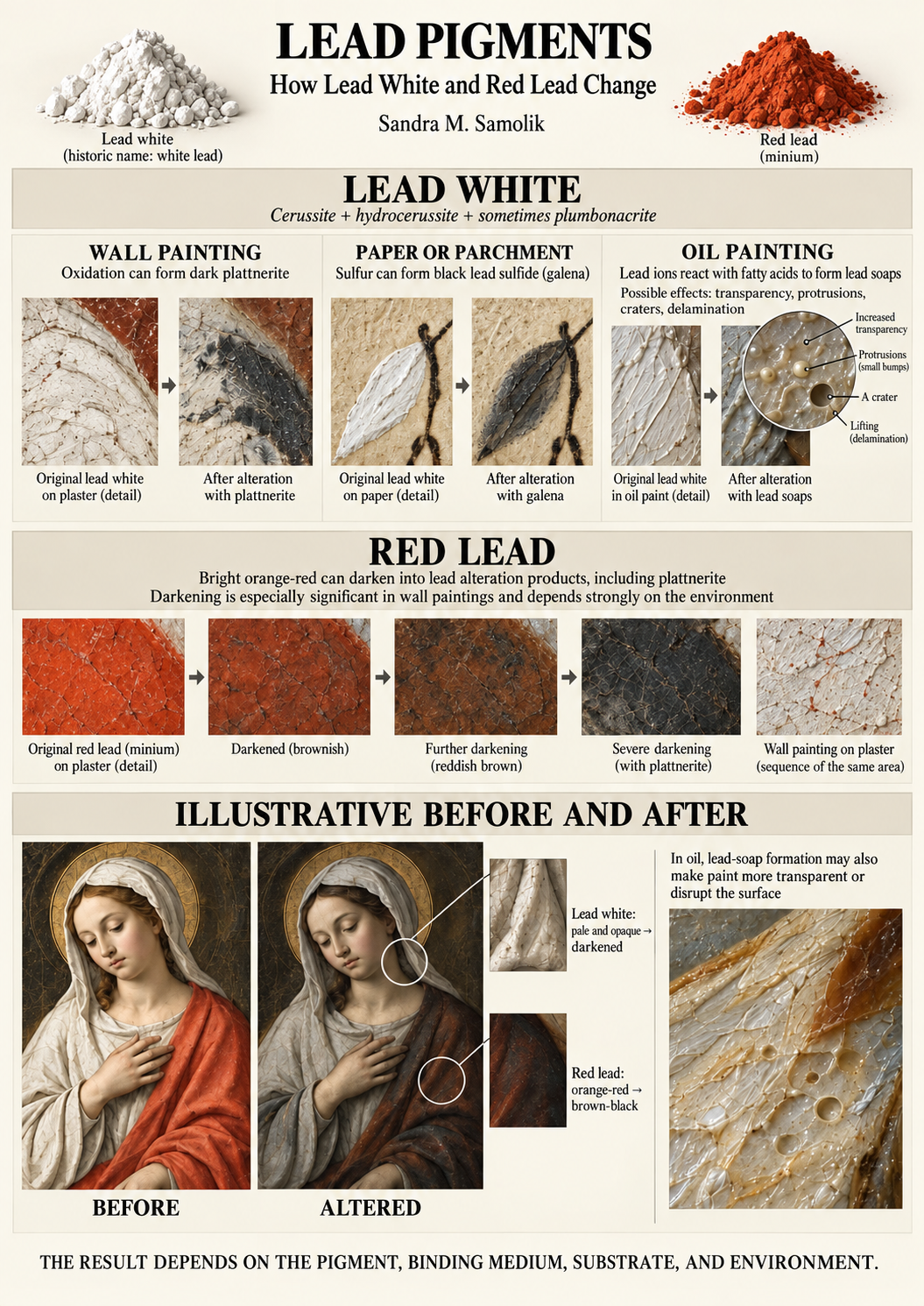
Lead white and red lead were valued for their opacity, luminosity, and handling properties, but neither pigment is chemically inert. Their appearance can change significantly depending on the binding medium, substrate, and surrounding environment.
Lead white generally contains cerussite and hydrocerussite, sometimes with plumbonacrite. On paper or parchment, sulfur-containing gases can react with these lead carbonates and form black lead sulfide, known as galena. In wall paintings, oxidation under sufficiently reactive conditions may instead produce dark lead dioxide, particularly plattnerite.
In oil paintings, the alteration can follow another pathway. Lead ions react with fatty acids released as the drying oil ages, forming lead soaps. These compounds may increase the transparency of the paint, allowing darker underlying layers to become visible. They can also aggregate into protrusions, craters, cracks, and areas of lifting or delamination. The paint may therefore appear darker even when the pigment itself has not transformed into a black compound.
Red lead, or minium, is a vivid orange-red pigment that is particularly vulnerable in wall paintings. It may gradually turn brown or black through conversion into altered lead compounds, including plattnerite. Moisture, pollutants, alkalinity, light exposure, salts, microorganisms, and neighboring materials can all influence the reaction.
Darkening is therefore not simply surface dirt. It can represent a fundamental chemical and physical transformation of the original paint. Because several mechanisms can produce similar visual effects, scientific examination is essential before any conservation treatment is considered.
© 2026 Sandra M. Samolik. All rights reserved. Text and figures on this page may not be copied, downloaded, or redistributed without prior written permission.