Pigments, Binders, Varnishes, and Artists’ Materials
Laser Cleaning of Stone Surfaces
Laser cleaning has become an important tool in the conservation of stone surfaces, but its effectiveness depends entirely on how carefully the treatment parameters are controlled.
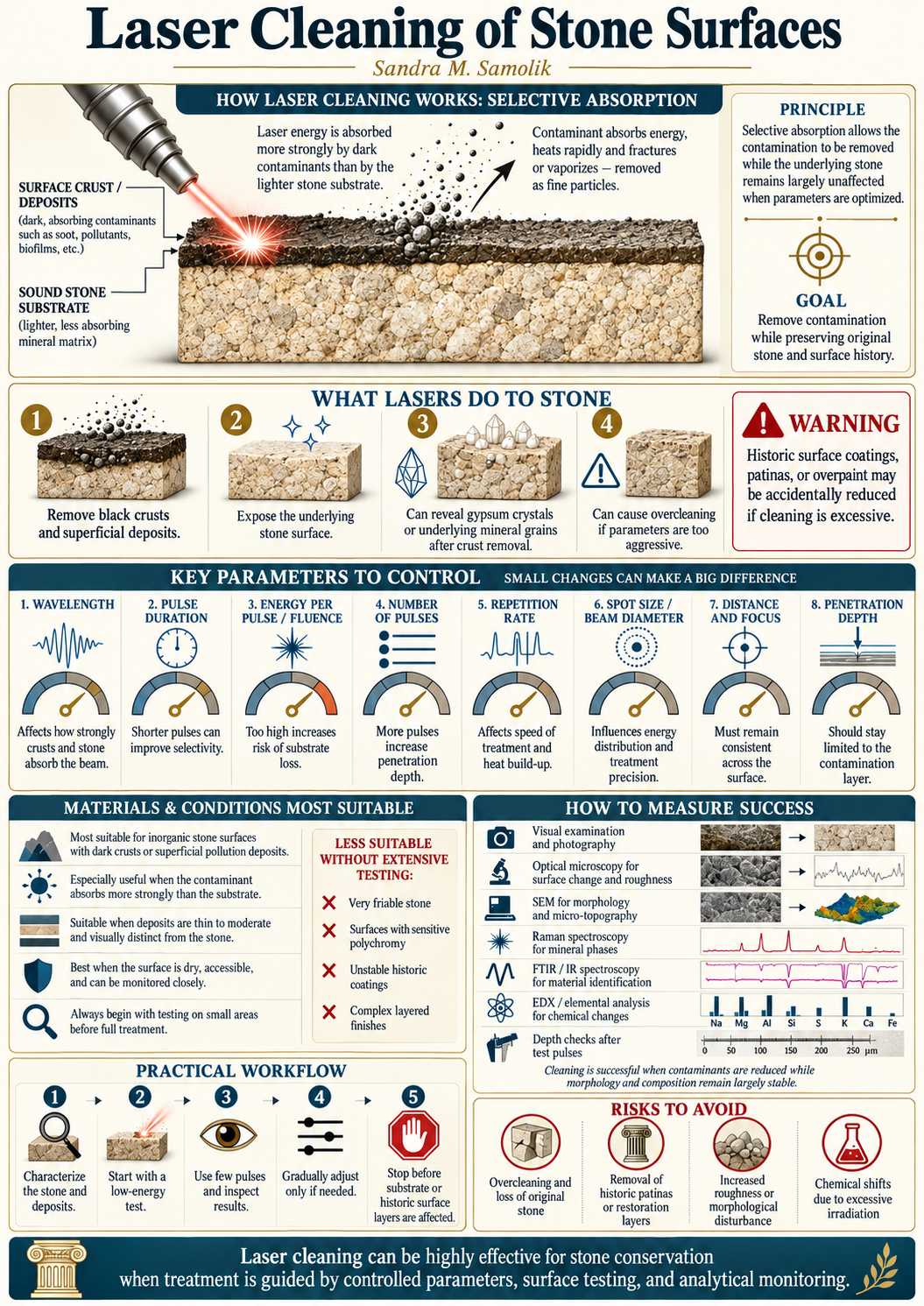
Laser cleaning has become an important tool in the conservation of stone surfaces, but its effectiveness depends entirely on how carefully the treatment parameters are controlled.
The principle is based on selective absorption: dark surface contaminants can absorb laser energy more strongly than the lighter stone substrate, allowing deposits to be removed while minimizing alteration of the underlying material. However, excessive energy or too many pulses can lead to overcleaning, increased penetration depth, loss of historic surface layers, or changes to the stone itself.
Successful laser cleaning therefore requires much more than simply applying a laser to a surface. Important variables include wavelength, pulse duration, fluence or energy per pulse, number of pulses, repetition rate, beam diameter, focus, and penetration depth.
Equally important is analytical monitoring. Optical microscopy, SEM, Raman spectroscopy, FTIR/IR spectroscopy, and EDX can help determine whether contamination has been removed without significantly altering surface morphology, mineral composition, or elemental composition.
One of the most important conservation principles is therefore simple:
Use the lowest effective energy and the fewest pulses necessary to achieve the desired cleaning result.
Small-area testing, continuous observation, and material characterization should always precede broader treatment. The goal is not to produce the “cleanest” possible surface, but to remove unwanted deposits while preserving the original material, historic patinas, and evidence of the object’s surface history.
Laser cleaning can be highly precise, but precision depends on understanding the interaction between laser, contaminant, substrate, and treatment parameters. As the study demonstrates, carefully selected conditions can remove surface contamination with little detectable morphological or chemical alteration, whereas excessive irradiation can result in overcleaning.
© 2026 Sandra M. Samolik. All rights reserved. Text and figures on this page may not be copied, downloaded, or redistributed without prior written permission.