Digital Heritage
False Provenance
False provenance is not only a problem of incorrect facts. It can also be a problem of language, documentation, and the way an ownership history is constructed. This post examines three well-known cases involving Knoedler and Glafira Rosales, Wolfgang Beltracchi and the fictitious “Jägers Collection,” and John Drewe and John Myatt. Each demonstrates a different way in which a convincing provenance narrative can be created.
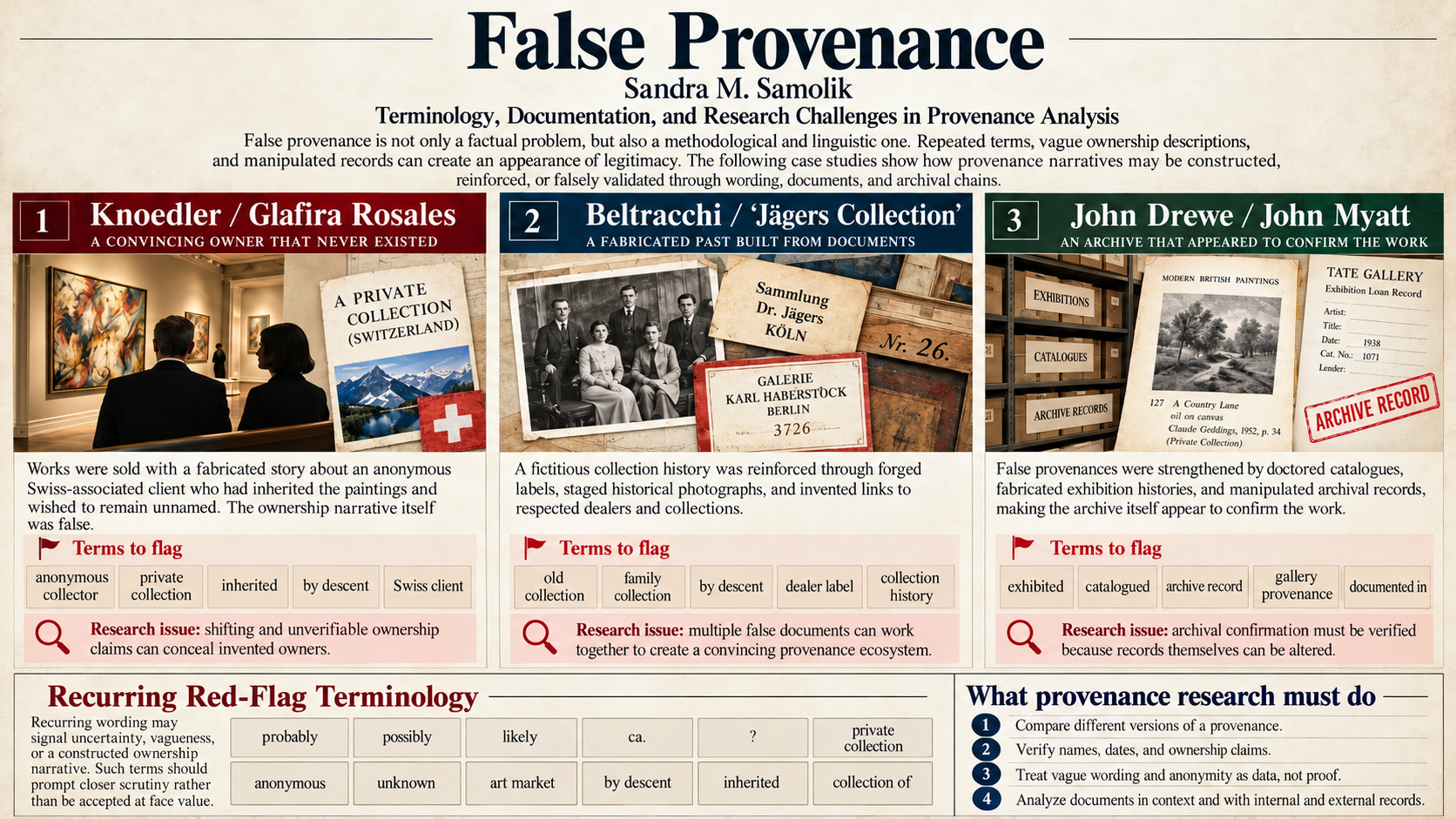
In the Rosales case, an anonymous Swiss-associated collector, inheritance, and privacy became part of a fabricated ownership history.
In the Beltracchi case, the deception went further. Invented collection histories were supported by labels, photographs, and supposed connections to established dealers and collectors, creating an entire documentary environment around the works.
The Drewe and Myatt case demonstrates an especially important problem for researchers: archival documentation itself can be manipulated. Exhibition histories, catalogues, records, and institutional references may appear to provide independent confirmation when they are actually part of the fabrication.
These cases also highlight the importance of terminology in provenance research.
Words and expressions such as:
probably • possibly • likely • circa • anonymous • unknown • private collection • art market • inherited • by descent • collection of
are not evidence of fraud in themselves.
They are, however, indicators of uncertainty, anonymity, or incomplete documentation and therefore deserve closer examination, especially when several appear within the same ownership history.
Provenance research requires more than finding a name in a catalogue or locating a reference in an archive. It requires comparison, chronology, contextual verification, and the ability to ask whether supposedly independent sources are actually repeating the same unsupported claim.
A convincing provenance narrative is not necessarily a verified provenance.
© 2026 Sandra M. Samolik. All rights reserved. Text and figures on this page may not be copied, downloaded, or redistributed without prior written permission.