Pigments, Binders, Varnishes, and Artists’ Materials
Digital Imaging for the Analysis of paintings
What begins as documentation can become a powerful analytical process, allowing us to examine aspects of an artwork that are difficult or impossible to observe with the naked eye.
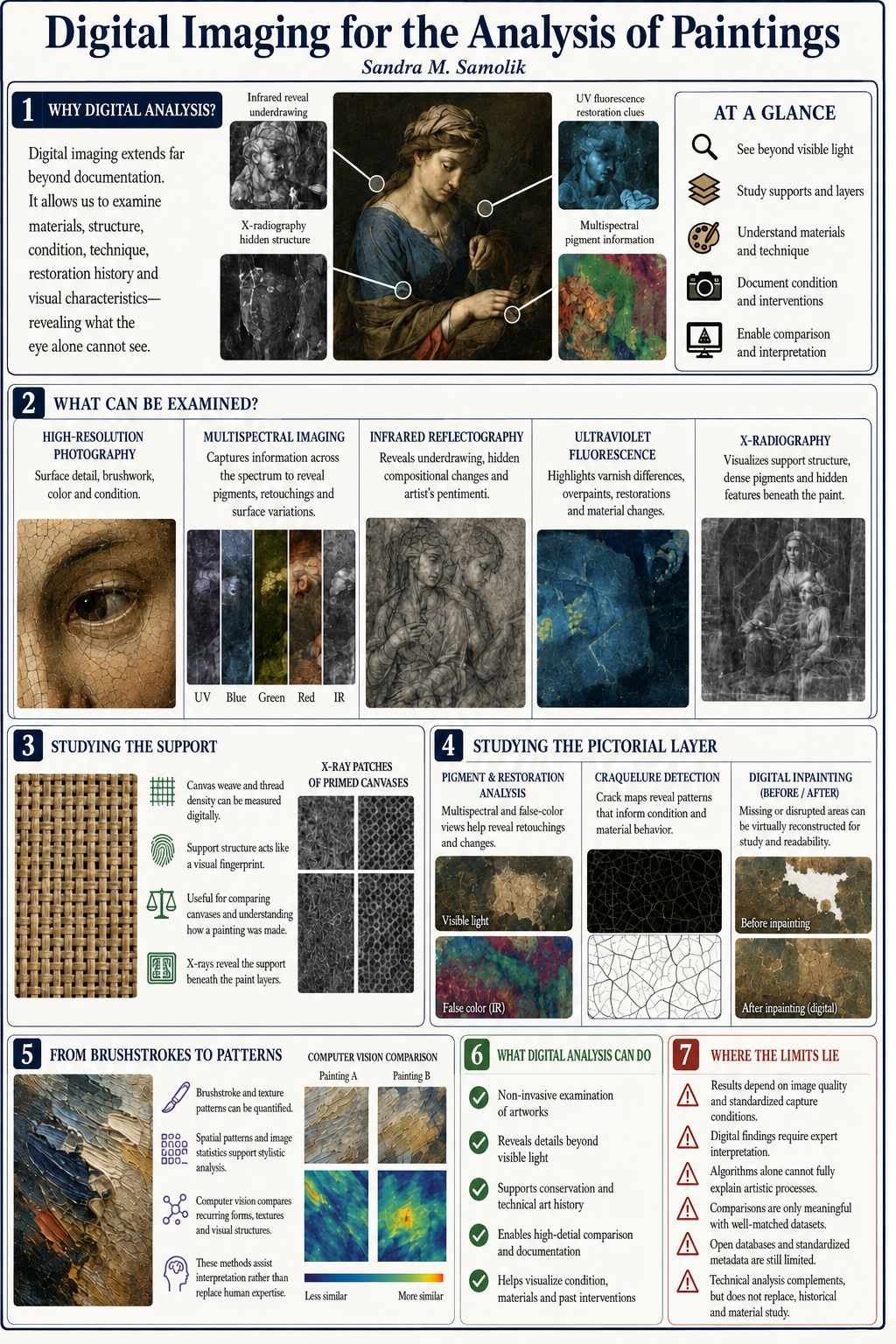
Digital imaging has transformed the way we analyze paintings.
What begins as documentation can become a powerful analytical process, allowing us to examine aspects of an artwork that are difficult or impossible to observe with the naked eye.
High-resolution photography can document surface texture, brushwork, craquelure and condition. Infrared reflectography can reveal underdrawing and compositional changes. Ultraviolet fluorescence can highlight varnish differences, retouching and previous interventions, while X-radiography can provide information about underlying structures, dense pigments and features beneath the visible paint surface. Multispectral imaging adds another layer by recording how materials respond across different wavelengths.
Digital methods can also be applied to the support itself. Canvas weave, thread density, crack networks, brushstroke structures and other visual characteristics can increasingly be measured, mapped and compared computationally.
But the limitations are equally important.
Digital analysis depends heavily on image quality, a high-resolution datasets, standardized acquisition conditions, appropriate datasets and expert interpretation. Algorithms can identify patterns and relationships, but they cannot independently explain why an artist selected a particular material, altered a composition, applied paint in a certain way or how an artwork changed throughout its history.
For me, this is where the greatest potential lies: not in replacing conservation, technical art history or connoisseurship, but in creating stronger connections between them.
Digital imaging becomes most valuable when computational analysis, material evidence and art-historical knowledge are interpreted together.
© 2026 Sandra M. Samolik. All rights reserved. Text and figures on this page may not be copied, downloaded, or redistributed without prior written permission.