Pigments, Binders, Varnishes, and Artists’ Materials
Chrome Yellow
Introduced commercially in the early 19th century, Chrome Yellow became one of the striking new colors available to artists during a period of rapid development in synthetic pigments.
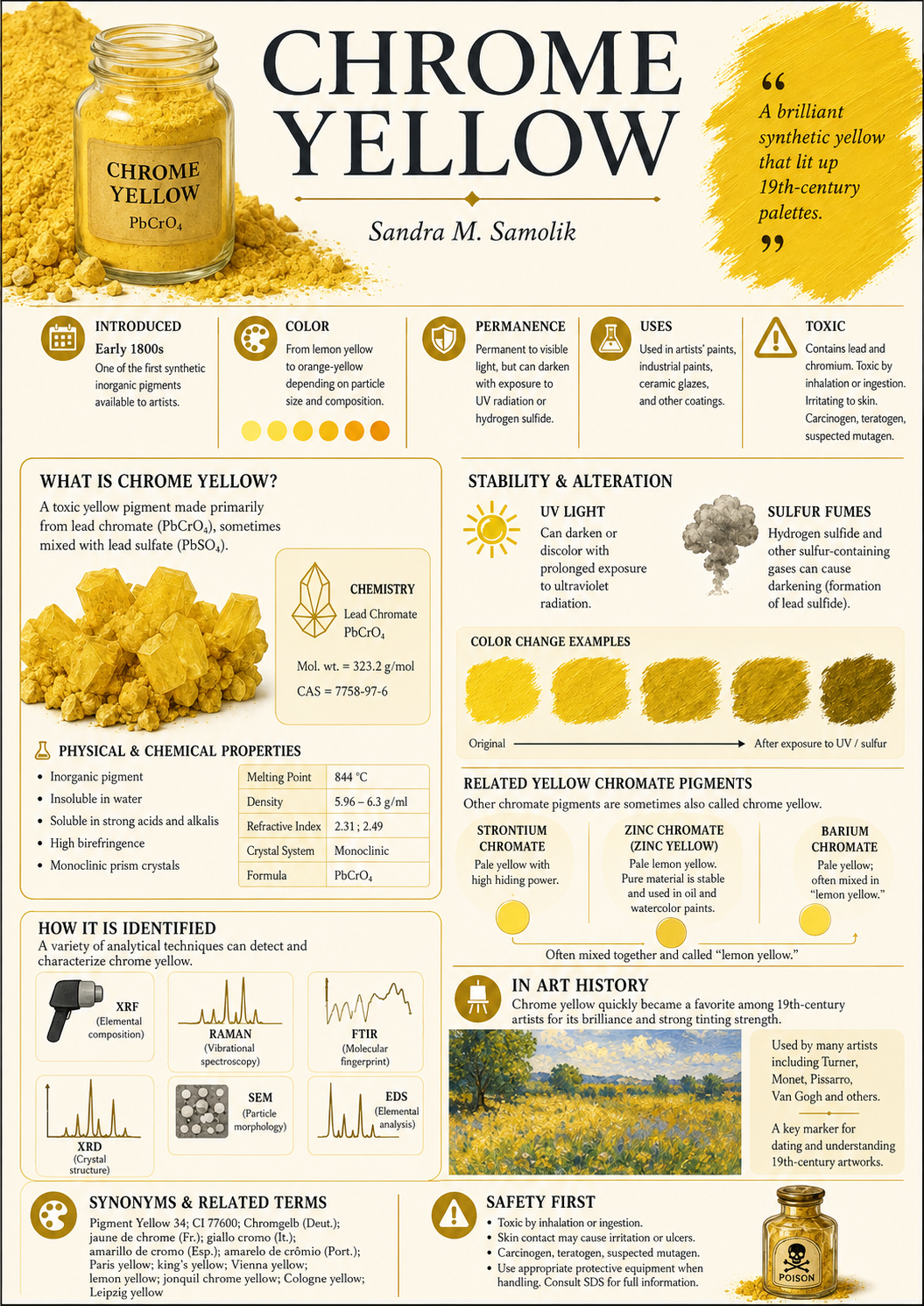
Chrome Yellow: Introduced commercially in the early 19th century, Chrome Yellow became one of the striking new colors available to artists during a period of rapid development in synthetic pigments.
Its primary component, lead chromate (PbCrO₄), can produce shades ranging from lemon yellow to deep orange yellow. But its brilliance comes with complications.
Chrome Yellow can undergo chemical alteration. Exposure to ultraviolet radiation and sulfur containing pollutants may cause discoloration and darkening, meaning that the yellow we see in a painting today may not necessarily represent what the artist originally saw on the palette.
This makes pigment identification particularly important in technical art history and conservation.
Analytical techniques including XRF, Raman spectroscopy, FTIR, XRD and SEM EDS can help identify and characterize Chrome Yellow, allowing us to better understand an artwork's materials, condition, degradation and history.
Because Chrome Yellow only became commercially available in the early 19th century, its identification in a supposedly much earlier painting could raise important questions about later interventions, restoration, or even authenticity.
A pigment is therefore much more than a color. It can be evidence.
© 2026 Sandra M. Samolik. All rights reserved. Text and figures on this page may not be copied, downloaded, or redistributed without prior written permission.