Pigments, Binders, Varnishes, and Artists’ Materials
Aureolin
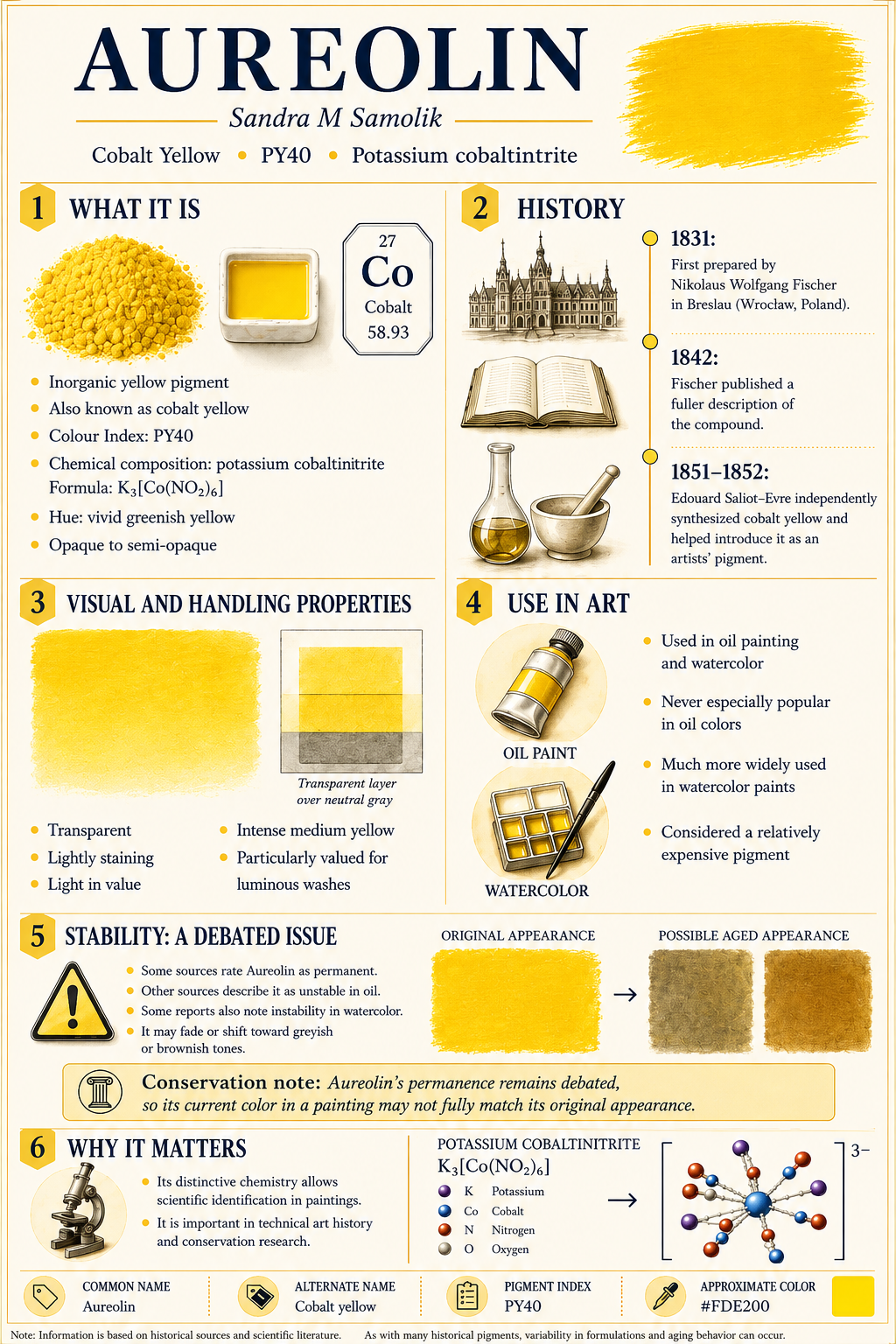
Aureolin, also known as Cobalt Yellow (PY40), was first prepared by Nikolaus Wolfgang Fischer in 1831 and later introduced as an artists’ pigment in the nineteenth century. Aureolin is a transparent, vivid yellow based on potassium cobaltinitrite. It became particularly valued in watercolor for its luminous, transparent washes, although it was never as widely used in oil painting.
Aureolin, also known as Cobalt Yellow (PY40), was first prepared by Nikolaus Wolfgang Fischer in 1831 and later introduced as an artists’ pigment in the nineteenth century. Aureolin is a transparent, vivid yellow based on potassium cobaltinitrite. It became particularly valued in watercolor for its luminous, transparent washes, although it was never as widely used in oil painting.
From a conservation perspective, Aureolin is especially interesting because its long-term stability remains debated. Different sources report varying degrees of permanence, with some observations describing fading or shifts toward greyish or brownish tones.
This is an important reminder that the color we see in a historic painting today may not always correspond exactly to the artist’s original intention.
Understanding pigments through their chemistry, manufacture, historical availability, optical properties, and aging behavior can provide valuable evidence for technical art history, conservation, provenance research, and authentication.
© 2026 Sandra M. Samolik. All rights reserved. Text and figures on this page may not be copied, downloaded, or redistributed without prior written permission.